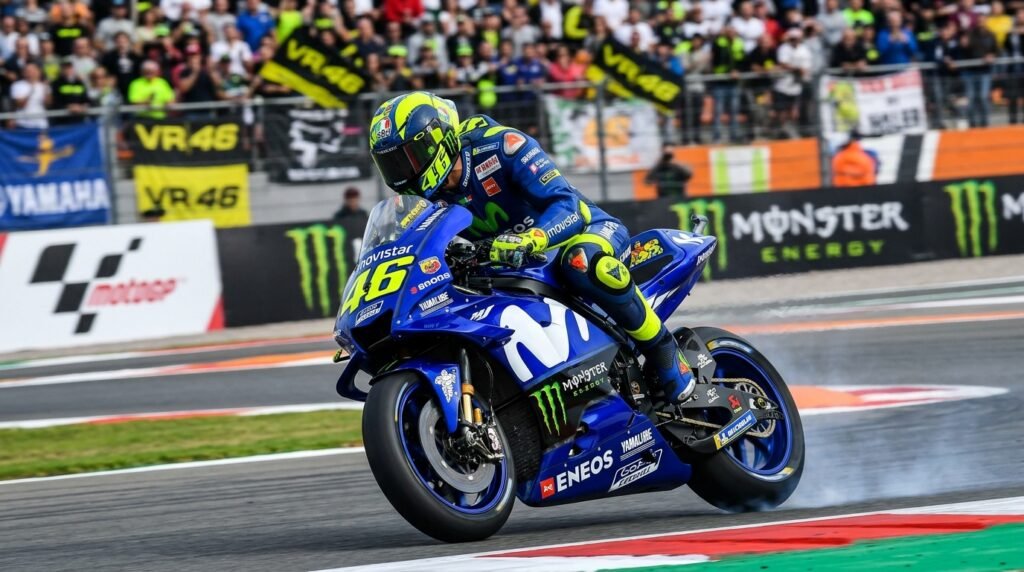

Valentino Rossi is one of the most recognizable names in motorcycle racing, celebrated for his exceptional talent, fearless overtaking, charismatic personality, and remarkable longevity. For millions of fans, watching Rossi race was about more than speed; it was about the excitement, strategy, and emotion he brought to every Grand Prix. Known worldwide as “The Doctor,” the Italian rider became a defining figure in the modern MotoGP era and helped introduce motorcycle racing to a much wider audience.
Born in Urbino, Italy, on February 16, 1979, Rossi developed a passion for motorsport at an early age. Over a career spanning more than two decades at world championship level, he won nine Grand Prix motorcycle racing world titles, including seven in the premier class. His achievements with Honda and Yamaha established him among the sport’s most successful competitors, while his famous number 46 became an international symbol of racing excellence.
This article explores Valentino Rossi’s early life, rise to fame, championship victories, racing style, famous rivalries, retirement, and work beyond competition. It also explains why his influence continues through the next generation of riders and the racing organizations he helped establish.
Who Is Valentino Rossi?
Valentino Rossi is a retired Italian professional motorcycle racer and a prominent figure in international motorsport. He competed in the 125cc, 250cc, 500cc, and MotoGP categories, winning world championships across all four classes.
Rossi was born in Urbino and grew up in Tavullia, a town in Italy’s Marche region that later became closely associated with his name and racing identity. His father, Graziano Rossi, was also a motorcycle racer, giving Valentino early exposure to competitive motorsport.
Valentino Rossi: Key Facts
- Full name: Valentino Rossi
- Date of birth: February 16, 1979
- Age in 2026: 47
- Birthplace: Urbino, Italy
- Nationality: Italian
- Nickname: The Doctor
- Famous racing number: 46
- Grand Prix world championships: 9
- Premier-class world championships: 7
- Grand Prix victories across all classes: 115
- Premier-class Grand Prix victories: 89
- Premier-class podium finishes: 199
- Grand Prix racing career: 1996–2021
These career figures are documented in MotoGP’s historical statistics. Rossi’s nine world titles include championships won in the 125cc, 250cc, 500cc, and MotoGP categories. His seven premier-class titles came during his years competing at the highest level of Grand Prix motorcycle racing.
Valentino Rossi’s Early Life and Family
Valentino Rossi grew up surrounded by motorsport. His father, Graziano, competed in motorcycle racing during the 1970s, and his experiences helped introduce Valentino to the demands of competitive riding.
Although Rossi was born in Urbino, his childhood and formative years were closely connected to Tavullia. The local environment, his family’s racing background, and his early interest in speed helped shape his ambitions.
Rossi initially competed in karting before concentrating on motorcycle racing. Karting gave him experience with competition, vehicle control, and race strategy, while his subsequent move to two wheels allowed him to develop the riding skills that would eventually distinguish him.
His progress through junior competitions demonstrated that he possessed more than enthusiasm. He showed the ability to adapt quickly, understand racing situations, and compete consistently against talented opponents.
An important lesson from Rossi’s early career is that elite performance develops through multiple stages. Natural ability can create opportunities, but technical training, competitive experience, and the willingness to learn are essential for turning potential into lasting success.
How Valentino Rossi Started His Professional Racing Career
Rossi entered the 125cc World Championship in 1996. In his first season, he earned his maiden Grand Prix victory at Brno in the Czech Republic, immediately demonstrating that he could compete internationally.
In 1997, he won the 125cc world championship. His performances combined speed with an entertaining personality that made him stand out from many other young riders.
The following year, Rossi moved into the 250cc category. He won the 250cc world championship in 1999, confirming that his success was not limited to the smallest Grand Prix class.
His next move was to the premier 500cc category in 2000, where he competed against experienced riders on powerful motorcycles. Rossi won his first race in the class at Donington Park in Britain and finished the championship as runner-up.
That season prepared him for the breakthrough that followed. Rather than relying on a single exceptional performance, Rossi had built a record of success across different motorcycle classes.
Valentino Rossi’s World Championship Wins
Rossi won nine Grand Prix motorcycle racing world championships during his career. Seven came in the premier class, where he became one of the most successful riders in the history of the sport.
His championships also demonstrate his ability to adapt to different motorcycles, technical regulations, teams, and competitors.
| Year | Championship category | Manufacturer |
|---|---|---|
| 1997 | 125cc | Aprilia |
| 1999 | 250cc | Aprilia |
| 2001 | 500cc | Honda |
| 2002 | MotoGP | Honda |
| 2003 | MotoGP | Honda |
| 2004 | MotoGP | Yamaha |
| 2005 | MotoGP | Yamaha |
| 2008 | MotoGP | Yamaha |
| 2009 | MotoGP | Yamaha |
Dominance With Honda
Rossi won the 500cc world championship in 2001, his first premier-class title. In 2002, the new MotoGP era began, featuring four-stroke motorcycles in the premier class.
He won the inaugural MotoGP championship with Honda and retained the title in 2003. These victories established him as the rider to beat during the early years of the new category.
His Honda success reflected outstanding racecraft, technical understanding, and the ability to manage pressure throughout a championship season.
The Famous Switch to Yamaha
One of the defining decisions of Rossi’s career was his move from Honda to Yamaha for 2004.
At the time, changing manufacturers created a major challenge. Rossi had to adapt to a different motorcycle while facing competitors who expected him to lose some of his advantage.
Instead, he won the 2004 championship and repeated the achievement in 2005. His immediate success with Yamaha strengthened his reputation as a rider capable of contributing to a motorcycle’s development rather than simply benefiting from the fastest available machine.
Returning to the Top
Rossi won MotoGP championships again in 2008 and 2009. These victories demonstrated that he could remain competitive as new rivals emerged and the technical demands of the sport continued to evolve.
The 2009 championship was his final world title. However, he continued racing at the highest level for more than a decade afterward, accumulating additional victories and podium finishes.
Valentino Rossi’s Most Memorable Racing Achievements
Championship totals tell only part of Rossi’s story. His career also featured remarkable comebacks, competitive milestones, and performances that helped define MotoGP for an entire generation.
1. Nine World Championships
Rossi’s nine world titles place him among the most successful Grand Prix motorcycle racers of all time. His ability to win championships across several categories illustrates his adaptability and long-term consistency.
2. Seven Premier-Class Championships
His seven premier-class titles were won between 2001 and 2009. They came during a period of major technical and competitive change in motorcycle racing.
3. 115 Grand Prix Victories
Rossi recorded 115 Grand Prix victories across the 125cc, 250cc, 500cc, and MotoGP classes. This total reflects success at different stages of his career, not simply dominance in one category.
4. 199 Premier-Class Podiums
His 199 premier-class podiums are another measure of his sustained competitiveness. Reaching the podium requires more than outright speed; it also demands race management, consistency, and the ability to respond to changing conditions.
5. Competitive Longevity
Rossi competed in the Grand Prix world championship from 1996 through 2021. Maintaining a competitive career across 26 seasons required continuous adaptation to different generations of motorcycles, racing styles, and opponents.
What makes these statistics particularly meaningful is their combination. A rider might achieve a high number of victories during a short period of dominance, but Rossi paired major championship success with an unusually long presence at the top level.
Valentino Rossi’s Racing Style and Strengths
Rossi became famous for his ability to combine speed with intelligent race management. Although modern motorcycle racing depends heavily on electronics, tyres, aerodynamics, and engineering, the rider’s decisions remain crucial.
Tactical Overtaking
Rossi often demonstrated an ability to identify opportunities during close battles. Rather than treating every corner as an isolated challenge, he could use a competitor’s position and the sequence of upcoming corners to plan an overtake.
Adaptability
His transition from Honda to Yamaha is one of the clearest examples of adaptability in his career. He succeeded with different manufacturers and across multiple technical eras.
Race Awareness
A successful rider must understand tyre performance, braking distances, track conditions, and the movements of surrounding competitors. Rossi’s experience allowed him to manage races strategically instead of depending exclusively on qualifying speed.
Confidence Under Pressure
Championships are decided across entire seasons, often when riders face injuries, mechanical problems, inconsistent results, or intense competition. Rossi’s repeated title-winning campaigns demonstrated his ability to perform under sustained pressure.
These strengths do not mean that he won every major contest. His career also included difficult seasons, crashes, and championship defeats. Understanding both sides provides a more accurate picture of what made him successful.
Valentino Rossi’s Famous Rivalries
Rossi competed against several generations of leading motorcycle racers. These rivalries helped shape the sport’s public identity and gave fans memorable examples of different approaches to competition.
Max Biaggi
The rivalry between Rossi and fellow Italian Max Biaggi attracted substantial attention. Their competition combined sporting ambition with a highly publicized personal tension, making their battles particularly compelling to Italian fans.
Sete Gibernau
Sete Gibernau emerged as one of Rossi’s important rivals during the early 2000s. Their close races demonstrated how small differences in braking, corner entry, and race positioning could determine the outcome of a Grand Prix.
Casey Stoner
Stoner’s speed and natural ability on different motorcycles presented Rossi with a new kind of challenge. Their 2008 competition included several memorable battles, particularly at Laguna Seca in the United States.
Jorge Lorenzo
Rossi and Jorge Lorenzo became teammates at Yamaha while also competing for championships. Their relationship illustrated the complicated balance between cooperation inside a racing team and the individual ambition required to become world champion.
Marc Márquez
Rossi and Marc Márquez produced some of the most discussed confrontations of the modern MotoGP era. Their competition intensified during the 2015 season, particularly as the championship approached its conclusion.
These rivalries mattered because they revealed different dimensions of Rossi’s career. He was not simply competing against the clock; he was constantly adapting to rivals with different strengths, personalities, and technical approaches.
Why Valentino Rossi’s Number 46 Is So Famous
The number 46 became inseparable from Rossi’s identity. He continued to use it throughout his Grand Prix career, even after winning championships that would have allowed him to display the number 1.
For many fans, the number represents loyalty to his personal identity rather than a single championship season.
Rossi’s recognizable colours, celebratory gestures, humour, and close relationship with supporters helped transform the number into a symbol of his wider sporting brand.
His nickname, “The Doctor,” also became a familiar part of international motorsport culture. The precise origin of the nickname has been discussed in different ways, so it is better not to treat one popular explanation as definitively established.
Rossi’s ability to connect with audiences was an important part of his success beyond the track. He attracted people who might not otherwise have followed every technical detail of motorcycle racing.
Valentino Rossi’s Ducati Years and Later Career
In 2011, Rossi joined Ducati after a highly successful period with Yamaha. The partnership generated enormous expectations, but the results were more difficult than anticipated.
The Ducati motorcycle presented different handling and setup challenges, and Rossi struggled to reproduce the level of success he had achieved with Honda and Yamaha. He did not win a Grand Prix during his two seasons with the manufacturer.
He returned to Yamaha in 2013 and won races again, confirming that he remained a competitive force.
Rossi finished runner-up in the championship in 2014, 2015, and 2016. The 2015 campaign was especially significant because he remained in contention for the title until the final race, where his championship hopes ended with Lorenzo taking the crown.
His later years included strong performances alongside difficult seasons. Although he no longer won championships, he continued to attract large audiences and remained a central figure in the sport.
Rossi announced his retirement from full-time Grand Prix motorcycle racing during 2021, bringing his 26-season world championship career to a close at the end of that year.
Valentino Rossi’s Life After MotoGP
Retirement from full-time Grand Prix racing did not mean leaving motorsport altogether. Rossi continued competing in four-wheel racing and expanded his involvement in developing younger motorcycle racers.
GT and Car Racing
After his MotoGP career, Rossi pursued competitive car racing, including GT events. This allowed him to continue testing his skills in a different form of motorsport while remaining connected to professional competition.
Motorcycle and car racing demand different techniques, but both require precision, consistency, technical feedback, and the ability to work effectively with a team.
VR46 Riders Academy
Rossi established the VR46 Riders Academy to support developing motorcycle racers. The program combines training, professional guidance, and opportunities to progress through competitive categories.
The academy has helped nurture riders including Francesco Bagnaia, Franco Morbidelli, and Marco Bezzecchi, who have gone on to compete at the highest levels of motorcycle racing.
Bagnaia became the first academy rider to win the MotoGP world championship, achieving the title in 2022. This represented an important milestone for Rossi’s long-term contribution to the sport.
VR46 Racing Team
Rossi also became involved in team ownership and management through the VR46 racing organization. Its MotoGP presence provides another way for him to influence the sport after retirement.
This development is especially significant because Rossi’s legacy is no longer measured only by his personal achievements. It can also be seen in the opportunities and competitive support available to younger riders.
What Made Valentino Rossi Different From Other Champions?
Rossi’s legacy rests on several connected qualities rather than one record alone.
First, he achieved championships in four Grand Prix categories, showing that his talent could transfer across different motorcycles and levels of competition.
Second, he maintained a high profile over a career that stretched across multiple generations of rivals. His continued presence helped create a connection between long-time fans and newer audiences.
Third, his personality made him unusually recognizable outside motorsport. His humour, celebrations, and willingness to engage with supporters gave his racing achievements a broader cultural impact.
Finally, his work with the VR46 Riders Academy and racing team has helped extend his influence beyond his own competitive career.
A useful way to understand Rossi’s legacy is to separate sporting success from sporting influence. His championships and victories measure what he accomplished as a rider. His academy, team, and enduring popularity show how he has continued to shape motorcycle racing after retirement.
Common Misconceptions About Valentino Rossi
Several misunderstandings appear frequently in discussions about Rossi’s career.
- He won nine MotoGP premier-class championships. This is incorrect. He won nine world titles across all Grand Prix classes, including seven in the premier class.
- He retired from all motorsport in 2021. He retired from full-time Grand Prix motorcycle racing, not from every form of competition.
- He won every championship with Yamaha. His titles came with Aprilia, Honda, and Yamaha.
- His career was successful only because of his motorcycles. Motorcycle performance is important, but his achievements across different manufacturers demonstrate his own contribution as a rider.
- His legacy is limited to his statistics. His academy, team involvement, and cultural influence are also important parts of his impact.
Distinguishing between these facts helps explain his career without exaggerating his achievements or overlooking the complexity of elite motorcycle racing.
FAQs About Valentino Rossi
How many world championships has Valentino Rossi won?
Valentino Rossi won nine Grand Prix motorcycle racing world championships. These included one 125cc title, one 250cc title, one 500cc title, and six MotoGP titles. Seven of his nine championships came in the premier class, combining the 500cc and MotoGP eras.
Why is Valentino Rossi called The Doctor?
Rossi is widely known by the nickname “The Doctor,” which became a defining part of his public identity. Several explanations for its origin circulate among fans and commentators, but the nickname is firmly associated with his long racing career. It is also closely linked to his famous number 46.
When did Valentino Rossi retire from MotoGP?
Rossi retired from full-time Grand Prix motorcycle racing at the end of the 2021 season. His final world championship season was with Petronas Yamaha SRT. He subsequently continued his involvement in motorsport through car racing, rider development, and the VR46 organization.
How many MotoGP races did Valentino Rossi win?
Rossi won 89 premier-class Grand Prix races, including victories in the former 500cc category and the modern MotoGP class. Across all Grand Prix categories, he recorded 115 victories. These figures help explain why he remains one of the sport’s most successful riders.
Is Valentino Rossi still involved in motorcycle racing?
Yes. Although he no longer competes full-time in MotoGP, Rossi remains involved through the VR46 Riders Academy and the VR46 racing organization. He also follows and supports riders connected to his program. His post-retirement work focuses partly on helping develop the next generation of competitors.
What is Valentino Rossi’s most important achievement?
There is no single universally accepted answer. His nine world championships, seven premier-class titles, and 115 Grand Prix victories are major sporting achievements. His move from Honda to Yamaha and his later work developing young riders also form important parts of his legacy.
Conclusion
Valentino Rossi’s career is one of the defining stories in modern motorcycle racing. From his early success in the 125cc and 250cc classes to his championship-winning years with Honda and Yamaha, he demonstrated exceptional adaptability, racecraft, and consistency. His nine world championships, 115 Grand Prix victories, and 199 premier-class podiums provide a remarkable statistical record.
Yet Rossi’s importance extends beyond trophies. His rivalries, distinctive personality, famous number 46, and connection with fans helped make MotoGP more recognizable around the world. Since retiring from full-time Grand Prix racing in 2021, he has continued contributing through the VR46 Riders Academy, team ownership, and other motorsport activities.
For anyone learning about motorcycle racing, Rossi offers a compelling example of how talent, preparation, adaptability, and personality can combine to create a lasting sporting legacy. His achievements remain an important part of Grand Prix history, while his work with younger riders ensures that his influence reaches beyond his own time on the starting grid.